
The company's decision may impact new projects, which are likely to get delayed, said sources in the know. Among the IT players that work with Macy's are Accenture, Cognizant, Tata Consultancy Services (TCS), and Infosys. Macy's is among the top 5-10 clients of these companies.

'The idea is to invest where there is opportunity.'

Investors' wealth plunged over Rs 3.91 lakh crore on Friday amid an extremely weak broader market trend. The BSE benchmark tanked 773.11 points or 1.31 per cent to settle at 58,152.92 after a weak opening. During the day, it tumbled 1,011.93 points to 57,914.10.

The likelihood is that India will maintain a moderately upbeat economic tempo -- well short of tearaway growth, explains T N Ninan.

The best possible way to deal with job uncertainty is accepting the fact that it could happen to anyone and if it does, then it is important to work on a multi-pronged strategy on how to get through it in the best possible manner, advises Sumit Sabharwal.

Between Friday's and Monday's close: Yields on 10-year bonds up 6 basis points, rupee slides 13 paise against dollar, Sensex ends flat

'At this point, it does not appear to be a Lehman Brothers kind of crisis, which had a domino effect on the financial system.'

FPIs have turned net sellers in 2022 after being net buyers in the last three years.

Gehlot made the announcement in the presence of Congress president Mallikarjun Kharge and former party chief Rahul Gandhi at a rally here on the sidelines of the "Bharat Jodo Yatra".

The primary and immediate impact of a depreciating rupee is on the importers who will have to shell out more for the same quantity and price. However, it is a boon for the exporters as they receive more rupees in exchange for dollars. The rupee depreciation has wiped away some of the gains that would have accrued to India from international oil and fuel prices dropping to pre-Ukraine war levels.

Given that the BJP made all these moves and that these moves were presumably approved by Modi if not directed by him, who should accept the responsibility for the party's rout? asks Aakar Patel.

'The potential headwind is that the Indian economy is likely to see a slowdown in growth rates over the next two years.'

The Indian economy is likely to grow at over 7 per cent in the current fiscal year, former Niti Aayog vice chairman Arvind Panagariya said on Wednesday, while observing that the growth rate should sustain next year too provided the forthcoming Budget does not have any negative surprises. Panagariya further said recessionary fears have been around for a while but so far neither the US nor the EU has gone into recession. "From the viewpoint of India, in terms of headwinds originating abroad, the worst is probably behind us," he told PTI.

Equity benchmarks had another rough day on Monday, with the Sensex plummeting 1,457 points and the Nifty tumbling to the 15,774 level, mirroring an extremely weak trend in global markets along with unrelenting foreign fund outflows. Index majors ICICI Bank, Infosys and Reliance Industries bore the brunt of heavy selling. The 30-share BSE Sensex tumbled 1,456.74 points or 2.68 per cent to settle at 52,846.70.

"At present, there are two main rate slabs under which sa majority of goods are covered -- five per cent and 12.5 per cent -- which will now increase to three (five per cent, 12 per cent and 18 per cent).Will this result in multiple litigations is anybody's guess."

'A stable and strong Pakistan with an anti-India mindset and hatred is not good for us.'

'Our competitiveness with China is very important.' 'If the exchange rate depreciates, it is good for us because it helps in our competitiveness.'

Gold prices have surged nearly 18 per cent, so far, in the calendar year 2022 (CY22) to around $2,050 per ounce against the backdrop of the ongoing Russia-Ukraine war and there is more headroom over the next few months, believe analysts at Goldman Sachs who expect the yellow metal to become costlier by another 25 per cent to $2,500 an ounce by the year-end. Goldman Sachs, earlier, had raised its 12-month gold price forecast to $2,150 per ounce considering that an impending US growth slowdown would lead to increased concerns of a US recession and incentivise 300 tonnes of inflows into gold ETFs. At the beginning of the Russia-Ukraine tensions, Goldman Sachs had suggested the resultant rally in commodities could deteriorate the developed market (DM) growth-inflation mix, increase concerns of a American recession, and push gold ETF inflows to 600 tonnes and, in turn, lift gold prices to $2,350 an ounce in 12 months.

Although the leaders are not on same page on many matters related to the party, they have apparently come together to check Tharoor's larger political ambition in the state, they said.

'Even during the pandemic we did it.' 'We think it's our responsibility to make sure that we manage the uncertainty.'


Foreign investors have pulled over Rs 6,400 crore from the Indian equity market in the first four trading sessions of the ongoing month when the Reserve Bank of India (RBI) and US Federal Reserve raised interest rates. Given the headwinds in terms of elevated crude prices, inflation, tight monetary policy among others, FPIs' flows in India are expected to remain volatile in the near term, Shrikant Chouhan, Head - Equity Research (Retail), Kotak Securities, said. Foreign Portfolio Investors (FPIs) remained net sellers for seven months to April 2022, withdrawing a massive amount of over Rs 1.65 lakh crore from equities. This was largely on the back of anticipation of a rate hike by the US Federal Reserve and due to the deteriorating geopolitical environment following Russia's invasion of Ukraine.

International oil prices have hit a six-month low, helping Indian fuel retailers breakeven on petrol but they continue to lose money on diesel - the most used fuel in the country, officials said. The world's best-known crude benchmark, Brent was trading at $94.91 per barrel on Thursday after concerns of a global recession led to it slipping to a six-month low of $91.51 on the previous day. The current rates are a relief to India, which is 85 per cent dependent on imports for meeting its oil needs.

Lump sum investments in equity and hybrid schemes of mutual funds (MFs) declined to Rs 17,900 crore in October - the lowest since January 2021. The fall in lump sum investments comes even as flows through systematic investment plans (SIPs) rose to a new all-time high of Rs 13,000 crore in October. The latest lump sum tally is just a third of the peak inflow of Rs 49,700 crore in July 2021.

India's economy contracted by 7.3 per cent in fiscal 2020-21. The pandemic, it said, will leave new economic scars and deepen pre-pandemic constraints.

Equity investors became poorer by over Rs 6.71 lakh crore on Thursday as domestic benchmark indices tumbled amid a global market meltdown. The 30-share BSE benchmark Sensex tanked 1,416.30 points or 2.61 per cent to settle at 52,792.23, tracking weak global markets and persistent foreign fund outflows. In line with the weak market trend, the market capitalisation of BSE-listed firms tumbled by Rs 6,71,051.73 crore to stand at Rs 2,49,06,394.08 crore.

'They have started becoming an important player, but not at the same level as they were in the earlier part of the decade.'

The speed at which he led the central bank in different areas -- ranging from internal reorganisation to inflation fighting, stabilising the currency, taking on rogue corporations, cleaning up bank balance sheets, and opening the sector -- makes one believe that Rajan knew he had only three years to do his job. A fascinating excerpt from Tamal Bandyopadhyay's MUST-READ Roller Coaster: An Affair with Banking.

The Reserve Bank's rate-setting panel, Monetary Policy Committee (MPC), began its three-day deliberations on Wednesday amid expectations of a status quo on benchmark rate mainly on account of uncertainty over the impact of the second wave of COVID-19 pandemic. Moreover, the fears of firming inflation may also refrain the MPC from tinkering with the interest rate in its bi-monthly monetary policy outcome to be announced on Friday. The RBI had kept key interest rates unchanged at the last MPC meeting held in April.

India's services sector remained in contraction territory for the third straight month in July, as business activity, new orders and employment declined further largely due to the COVID-19 pandemic and local restrictions, a monthly survey said on Wednesday. The seasonally adjusted India Services Business Activity Index rose from 41.2 in June to 45.4 in July, but was stuck in the red due to subdued demand conditions amid the COVID-19 crisis. In Purchasing Managers' Index (PMI) parlance, a print above 50 means expansion, while a score below 50 denotes contraction.

Warning that the new year will be riskier than the previous two in terms of growth, inflation and the perils of monetary policy normalisation on consumption demand in particular, along with other external risks, a Wall Street brokerage has pencilled in an 8.2 per cent GDP growth next fiscal, with more downside risks to the projection. The biggest risk to the projection is a derailed consumption demand that has been the main growth driver in the past many years, said the Bank of America Securities India house economists who still believe that consumption demand will remain the key driver of growth next fiscal as well.

Equity indices nursed losses for the second consecutive session on Tuesday as investors continued to dump IT, banking and FMCG stocks amid a bearish trend in global markets. Unabated foreign fund outflows and the rupee dropping to another record low against the US dollar added to the woes, traders said. Participants were also in wait-and watch mode ahead of release of retail inflation and factory output data.
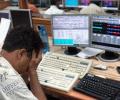
Equity benchmarks nosedived on Friday, with the Sensex crashing 866.65 points to close below the 55,000-mark amid a sell-off in global markets. Unabated foreign fund outflows and firm crude oil prices also weighed on sentiment. The 30-share BSE Sensex dived 866.65 points or 1.56 per cent to finish at 54,835.58.

Deepening the funding crisis that startups have been witnessing for some time, the October inflows plunged 75 per cent on-year to $3.3 billion across 75 deals, including six large deals worth $2.2 billion, according to an industry report. Exits touched half of the inflows at $1.6 billion across 15 deals in the reporting months, a significant improvement over the previous month which saw just $653 million worth of exits across 24 deals, but 69 per cent lower on-year basis, according to the numbers collated by EY for the Indian Private Equity & Venture Capital Association, the umbrella body the PEs and VCs. However, the report said, on a month-on-month basis, the inflows continued to grow, clipping at 60 per cent over the September numbers.

'I don't see any major setback for the Indian markets post the US Fed event.'

Opposition parties, including the Congress, Trinamool Congress, Bharat Rashtra Party and Samajwadi Party, came together in a show of unity on Thursday and accused the Modi government of getting the second half of the budget session washed out, while asserting that if this attitude continues, the country will move towards a "dictatorship".

Bajaj Finance was the biggest loser in the Sensex pack, tanking up to 8 per cent, followed by Hero MotoCorp, IndusInd Bank, Maruti and HCL Tech. Axis Bank, ITC, NTPC and M&M were among the top gainers.

Market benchmarks gave up intra-day gains to close in the red for the sixth session on the trot on Friday, capping a bruising week which saw a massive dash for safety amid rate hikes by global central banks and fears of slowing growth.

Benchmark indices failed to hold on to early gains and closed in the red for the seventh straight session on Thursday, with participants remaining in wait-and-watch mode ahead of the RBI's interest rate decision. Unabated selling by foreign funds added to the pressure, though a modest recovery in the rupee cushioned the fall, traders said. After rallying in early trade, the 30-share BSE Sensex came under selling pressure in the afternoon session and closed 188.32 points or 0.33 per cent lower at 56,409.96.
Titan, Maruti Suzuki India, Asian Paints, Mahindra & Mahindra and Hindustan Unilever Limited were the biggest drags on the Sensex, tumbling up to 5.05 per cent. In contrast, ITC, Dr Reddy's Laboratories, Tech Mahindra and UltraTech Cement were among the gainers.
 © 2026 Rediff.com - Advertise with us - Disclaimer - Privacy Policy - Sitemap - Feedback - About us - Terms of use - Grievances